Advances in prenatal imaging have transformed pregnancy care. High-resolution ultrasound machines, advanced Doppler studies, and sophisticated software now allow doctors to visualize the developing fetus in extraordinary detail.
However, in fetal medicine, one fundamental principle remains unchanged:
Even the most advanced technology cannot replace correct timing.
In prenatal diagnosis, when a scan is performed often matters more than how advanced the machine is.
Technology Shows Images — Timing Gives Them Meaning
Modern ultrasound equipment can detect fine anatomical details, but fetal development follows a precise biological timeline. Organs mature in stages, and many conditions can only be identified—or confidently ruled out—during specific gestational windows.
A scan performed too early may appear reassuring but miss evolving abnormalities.
A scan performed too late may detect a problem, but limit available options.
This is why accurate prenatal diagnosis depends on aligning technology with developmentally appropriate timing.
Key Diagnostic Windows in Pregnancy
First Trimester: Early Insight, Not Final Answers
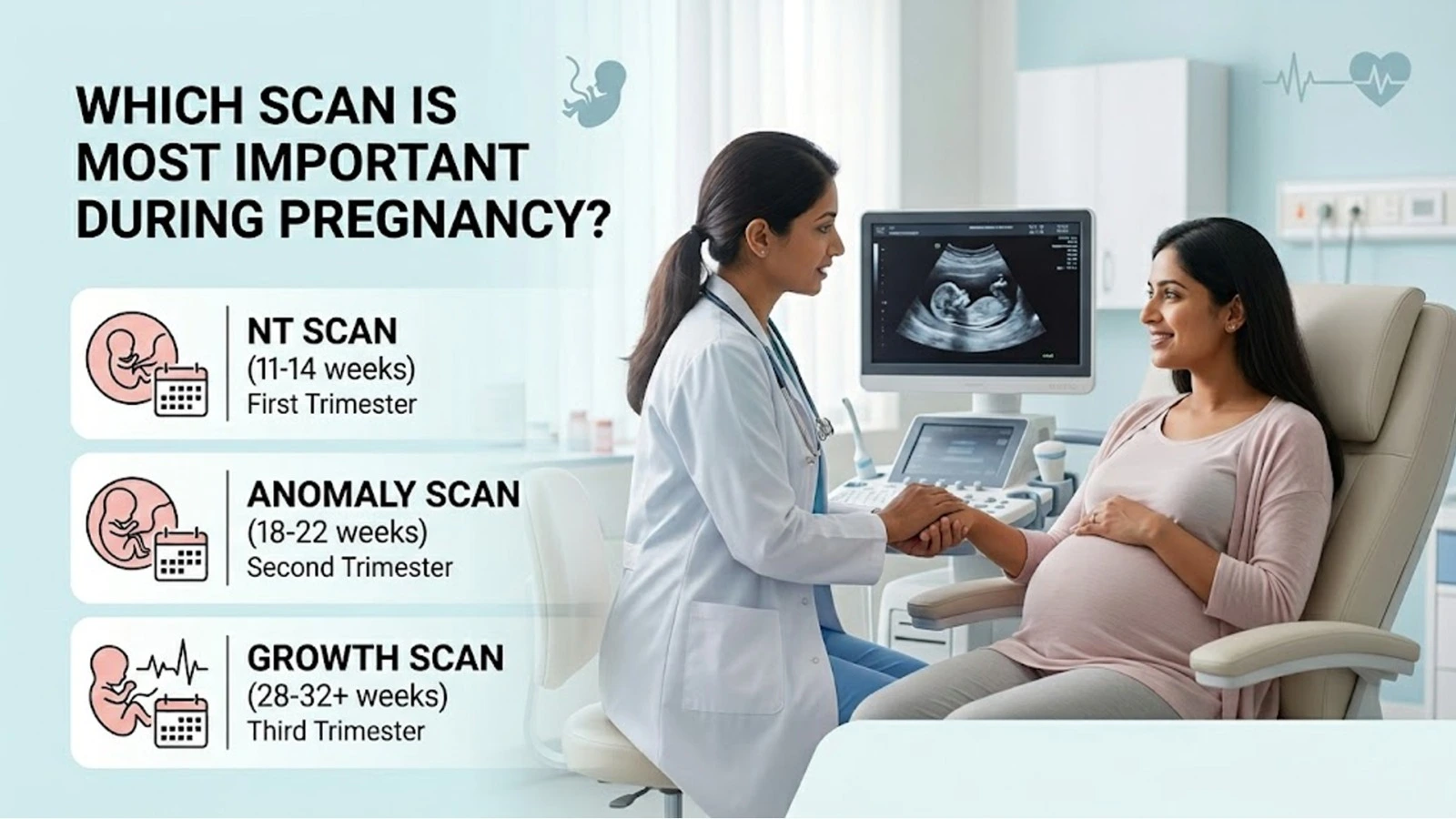
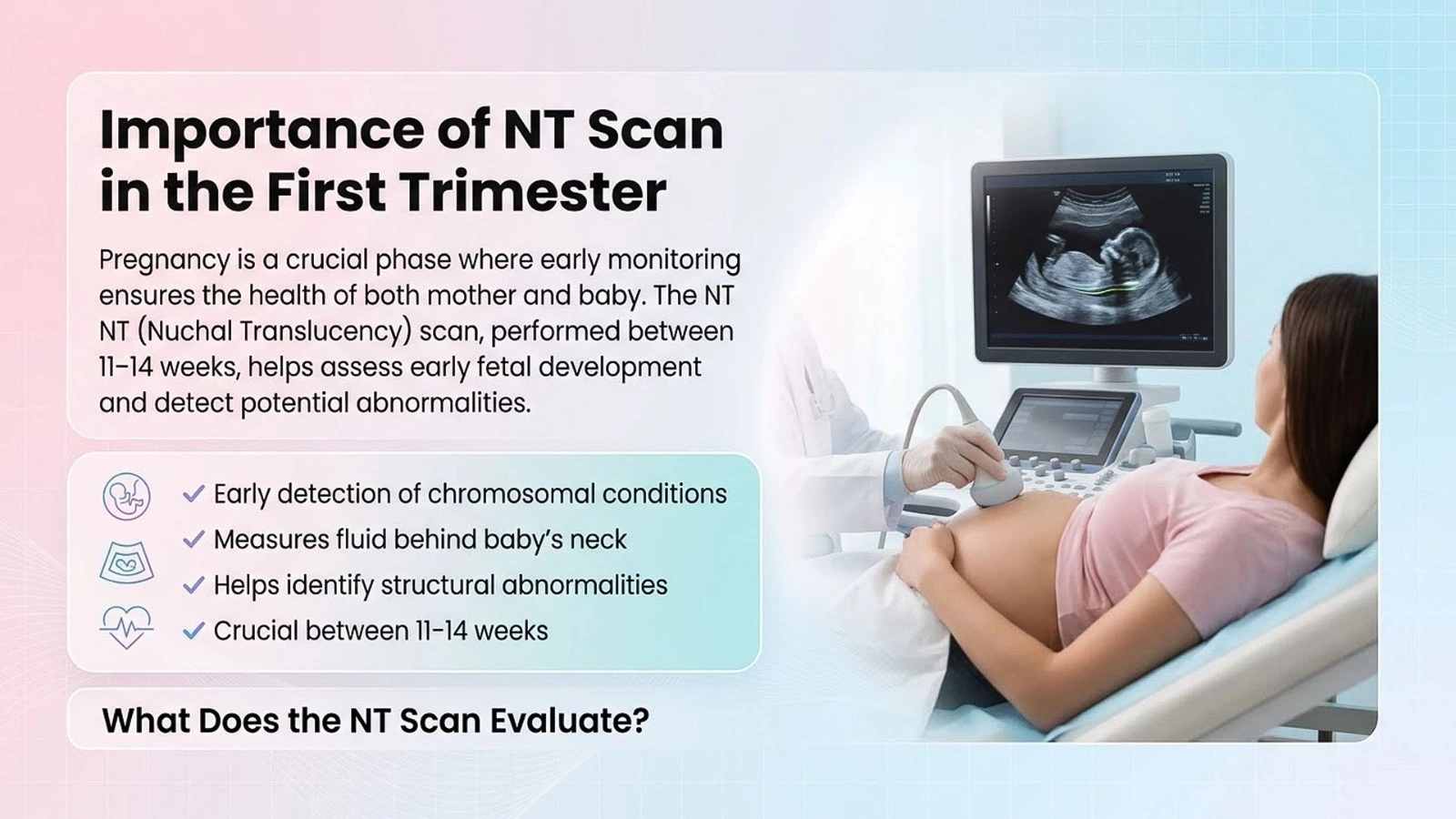
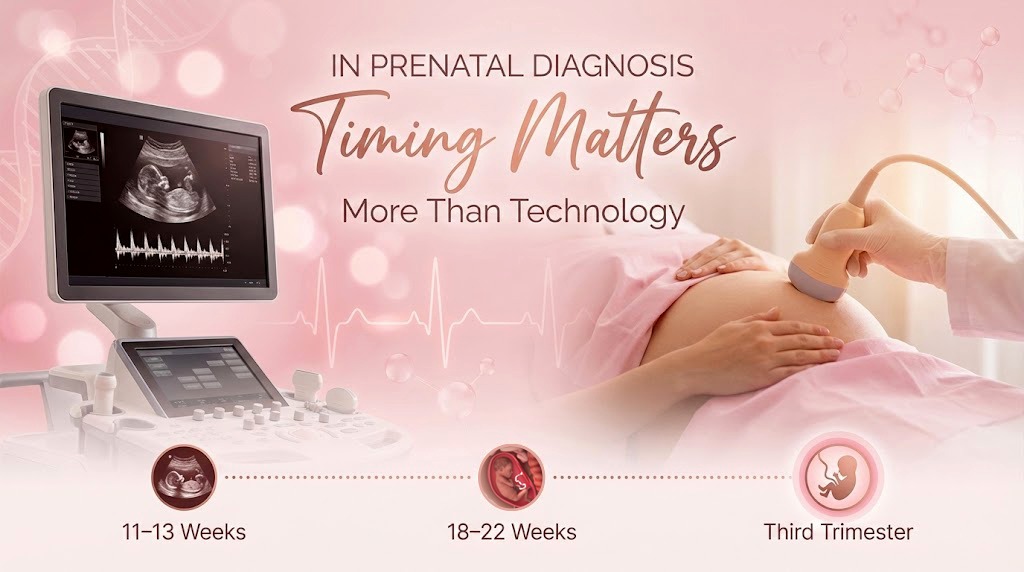
The first trimester is often misunderstood as a routine confirmation stage. In reality, the 11 to 13+6 week window provides crucial early information.
During this period:
Certain chromosomal risks can be screened
Early structural patterns begin to emerge
Some abnormalities can be suspected, but not confirmed
Scans performed outside this window reduce diagnostic accuracy, regardless of machine quality.
Mid-Trimester: Why the Anatomy Scan Has a Fixed Window
The detailed fetal anatomy scan is ideally performed between 18 and 22 weeks of pregnancy.
At this stage:
Fetal organs are sufficiently developed
Amniotic fluid allows optimal visualization
Fetal size enables accurate structural assessment
Scans done earlier may miss conditions because development is incomplete.
Scans done later may detect abnormalities but with reduced clarity and fewer management options.
Technology cannot alter fetal biology — timing works with it.
Late Pregnancy: Function Becomes More Important Than Structure
In the third trimester, most organs are already formed. The focus shifts from anatomy to function and adaptation.
Late pregnancy scans assess:
Fetal growth trends
Placental function
Blood flow patterns
Signs of fetal compromise
Even with advanced machines, interpretation depends on gestational age and progression over time, not a single scan.
Why Advanced Machines Can Still Miss Problems
A common misconception is that better machines guarantee perfect detection. In reality, abnormalities may be missed because:
The organ has not matured yet
The condition develops gradually
The issue is functional rather than structural
The scan timing does not match the diagnostic window
A normal scan at the wrong time does not always guarantee a normal outcome.
The Role of the Fetal Medicine Specialist
Prenatal diagnosis is not about performing more scans. It is about performing the right scan at the right time.
A fetal medicine specialist:
Chooses appropriate scan timing
Interprets findings in developmental context
Understands what can and cannot be concluded at each stage
Plans follow-up based on evolving risk
Machines provide data. Expertise provides meaning.
Why Follow-Up Scans Are Sometimes Essential
Parents often question the need for repeat scans after a normal report. The reason is simple:
Pregnancy risk is dynamic, not static.
Some conditions:
Emerge later in pregnancy
Require trend analysis
Cannot be identified in a single snapshot
Repeat scans improve accuracy and reduce false reassurance.
Technology Is a Tool. Timing Is the Strategy.
Advanced imaging is invaluable, but it is only effective when used at the correct stage of pregnancy. Correct timing:
Improves detection accuracy
Reduces unnecessary anxiety
Prevents missed diagnoses
Enables timely clinical decisions
Prenatal diagnosis is not about scanning more — it is about scanning wisely.
Key Takeaway for Expectant Parents
If a scan is recommended at a specific time, it is based on evidence, not routine. Trust the process, not just the machine.
The goal of fetal medicine is informed care, not excessive testing.
FAQs
Does advanced ultrasound technology guarantee detection of all fetal abnormalities?
No. Advanced ultrasound improves image quality, but abnormalities that are not developmentally visible at the time of scanning cannot be detected. Accurate diagnosis depends on correct timing.
Why can an early scan be normal while later scans show abnormalities?
Some fetal conditions develop or become visible only as organs mature. Early scans may appear normal because the affected structure has not fully developed.
What is the most accurate time for a detailed fetal anatomy scan?
The most accurate time is between 18 and 22 weeks of pregnancy, when fetal organs are sufficiently developed for reliable assessment.
Can abnormalities be missed even with high-resolution ultrasound machines?
Yes. Abnormalities can be missed if scans are performed outside the appropriate diagnostic window, regardless of machine quality.
Why are repeat scans advised after a normal report?
Pregnancy is dynamic. Some conditions evolve over time and require monitoring of growth patterns, placental function, and blood flow through serial scans.
Is earlier scanning always better in pregnancy?
No. While early scans are useful for dating and screening, many conditions can only be accurately assessed at specific gestational stages.
What is the role of a fetal medicine specialist beyond scanning?
A fetal medicine specialist determines scan timing, interprets findings in developmental context, assesses evolving risk, and guides follow-up care.
Are late-pregnancy scans necessary if earlier scans were normal?
Yes. Late-pregnancy scans help detect growth restriction, placental insufficiency, and late-onset complications that may not appear earlier.
Should parents interpret ultrasound reports on their own?
No. Ultrasound reports require clinical interpretation. Reviewing results with a specialist prevents misinterpretation and unnecessary anxiety.
What matters more in prenatal diagnosis: technology or timing?
Timing matters more. Technology enhances visualization, but accurate diagnosis depends on performing the right scan at the right stage of fetal development.